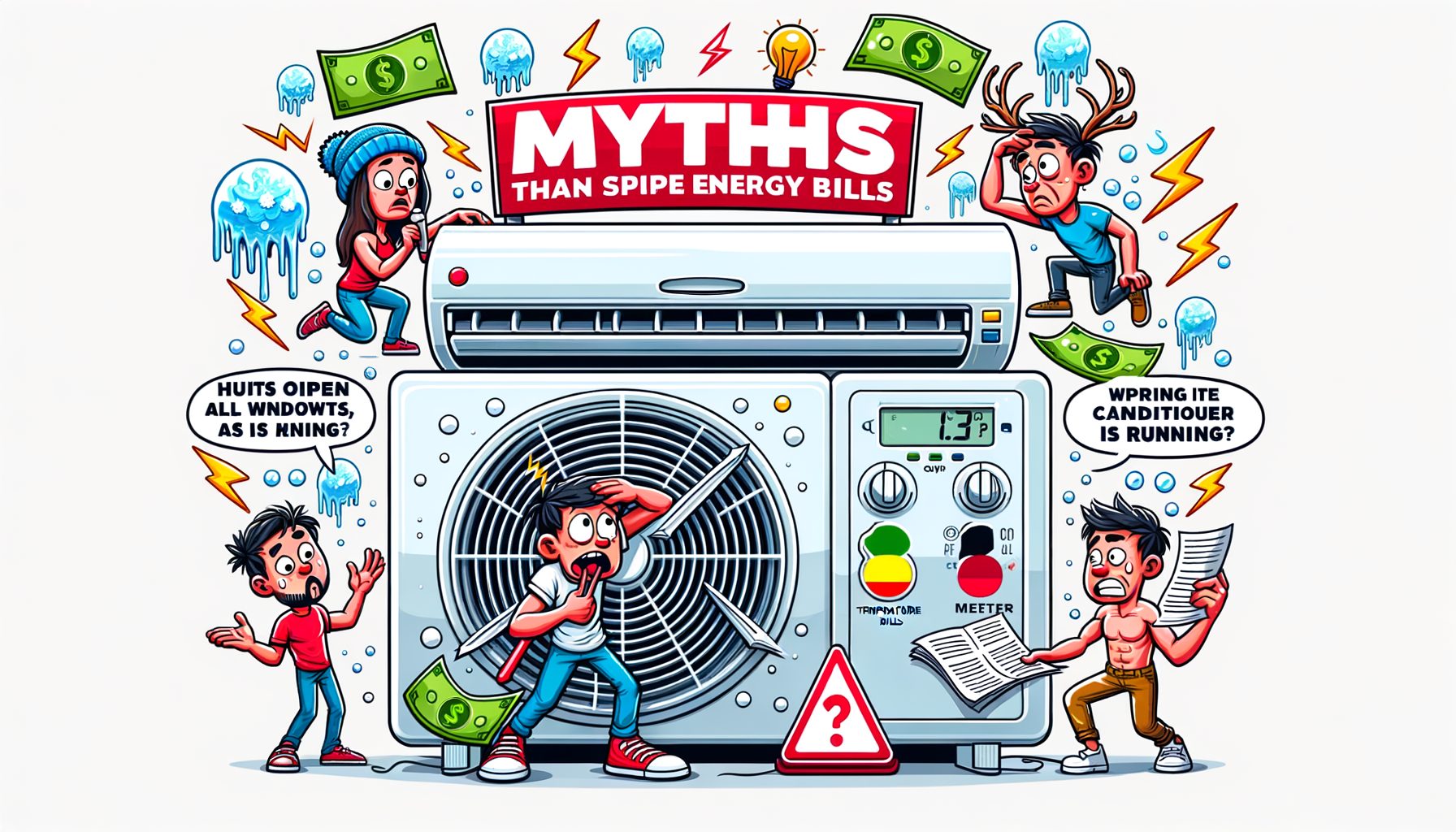
Many households wrestle with high electricity costs in hot seasons, and air conditioning often tops the energy-use chart. Surprising, right? A large chunk of those costs traces back to habits rooted in misinformation. In this guide, we unpack Air Conditioner Temperature Myths That Spike Energy Bills and show smarter ways to stay cool without giving up comfort. If you have ever cranked the thermostat down to “cool faster,” left the AC running all day, or skipped using a fan because “it does nothing,” you can start saving money immediately with a few simple, proven changes.
Myth 1: “Setting the thermostat much lower cools the room faster”
One of the most common air-conditioner myths sounds logical at first. However, almost all residential AC systems—especially single-stage units—cool at a fixed rate. When you set the thermostat from 27°C (81°F) down to 18°C (64°F), the unit does not blow colder air or cool faster; it just runs longer. That longer run time often overshoots your real comfort point, wastes energy, and can even make the room uncomfortably cold before you turn it back up. If you have a variable-speed or inverter system, output is modulated, but the cooling rate still follows equipment limits, not your setpoint. In short, a lower number does not “add turbo.”
What actually speeds up how you feel is reducing heat gains and improving air mixing. Close shades on sun-facing windows, cut appliance use during peak heat, and run the system’s fan on auto (or low) to avoid pushing moist, unconditioned air through ducts too quickly. Need a quick comfort boost? Flip on a ceiling or pedestal fan to increase air movement; the wind-chill effect makes you feel cooler within seconds, even before the room temperature drops.
Setting extremely low temperatures brings hidden costs. Every degree below your true comfort point increases compressor runtime and energy draw. Based on guidance from energy agencies, raising your thermostat by around 3–4°C (7–10°F) for portions of the day can save up to 10% annually. That implies the reverse is also true: lowering your setpoint below what you actually need drives costs up. A practical technique is to identify your comfort “sweet spot”—for many homes that is around 26°C–27°C (78°F–80°F) while occupied—and stick to it consistently. If you are just arriving home and it feels warm, set the thermostat to your target comfort temperature (not lower) and turn on a fan for 10–15 minutes. Doing so keeps comfort high and bills low—no myths, no guesswork.
Real-life example: In a mid-size apartment with a 2.5 kW split system, choosing 24°C (75°F) versus 21°C (70°F) can increase daily runtime by more than an hour during hot afternoons, depending on insulation and solar gain. Across a month, that extra runtime compounds, adding a noticeable bump to your electricity bill with minimal comfort benefit. The fastest way to feel better fast is airflow, shading, and a realistic setpoint—not a drastic temperature drop.
Myth 2: “Leaving the AC on all day uses less energy than turning it up when you’re out”
The myth persists because people assume reheating or recooling a space uses more energy than maintaining a constant temperature. In reality, heat flow is driven by the difference between indoor and outdoor temperatures. If your home stays cooler than outside for hours while nobody is there, heat will leak in anyway—and your AC must keep removing it. Raise your setpoint while you are away to reduce that temperature difference and cut the heat that leaks into the space, lowering energy use. It follows the same logic as winter setbacks for heating, just in reverse. When you return, your AC cools the smaller amount of accumulated heat, often faster than expected if shading and ventilation are good.
Energy agencies generally recommend using a programmable or smart thermostat to raise your cooling setpoint when you are away. A common target is 26°C–29°C (78°F–84°F) while away and about 26°C (78°F) when home. The U.S. Department of Energy estimates that raising your thermostat by about 7–10°F (4–6°C) for 8 hours a day can save up to 10% on annual cooling costs. If humidity runs high in your climate, a moderate setback (for example, 3–4°C) balances savings with moisture control. What’s interesting too, smart thermostats with geofencing can automate this, so your home begins cooling as you head back, ensuring comfort on arrival without wasted runtime.
Consider a real-world scenario: You work outside the home from 9 a.m. to 6 p.m. If you set your thermostat to 27°C (81°F) while away instead of holding it at 24°C (75°F), you shrink the temperature gap against a 33°C (91°F) outdoor day by 3°C (5–6°F). Less heat enters, and your AC runs less. When you return, your system cools back down within minutes to your comfort setpoint, especially if shades were drawn and internal heat sources (like ovens or gaming PCs) were minimized.
Estimated savings from setpoint adjustments (illustrative ranges):
| Setpoint Increase While Away | Typical Daily Away Duration | Estimated Cooling Energy Savings |
| +1°C (+2°F) | 8 hours | ~1–3% |
| +2°C (+4°F) | 8 hours | ~3–6% |
| +3–4°C (+5–7°F) | 8 hours | ~6–10% (per DOE guidance) |
Tip: Combine setbacks with passive cooling. Close blinds during the day, seal obvious air leaks, and avoid cooking during peak heat. Then this: recovery gets faster and humidity stays in check. If your home struggles to cool down by evening, the culprit is likely insulation, infiltration, or window gain—not the act of using setbacks. Addressing those upstream problems delivers permanent savings.
Myth 3: “Fans do not help with AC—They just waste electricity”
Fans do not lower a room’s air temperature; they cool people by increasing evaporation from your skin. That does not make them pointless—quite the opposite. A small fan’s wind-chill effect lets you raise the thermostat by about 1–2°C (2–4°F) while feeling equally comfortable. Since a typical ceiling fan uses 15–70 watts and a pedestal fan 30–60 watts, the power draw is tiny compared to an AC compressor that can draw 500–3,500 watts depending on size and type. The math is compelling: if a fan allows a 1–2°C setpoint increase that reduces compressor runtime or load, you save more energy than the fan uses, often by a wide margin.
Imagine you usually set 24°C (75°F). Turning on a ceiling fan and nudging the thermostat to 26°C (78°F) can maintain comfort for many people while trimming AC energy consumption. In a well-insulated room, the compressor cycles less often, and when it does run, it runs for shorter durations. In humid climates, using a moderate fan speed helps your body feel cooler without pulling humid, unconditioned air in from outside. Keep doors and windows closed during active cooling unless you are using a ventilation strategy tailored to your climate and time of day.
Important best practices: Turn fans off when leaving the room. Fans cool people, not rooms, so running them in empty spaces wastes energy. Keep fan blades clean to maintain airflow efficiency. Use counterclockwise rotation in summer (downward airflow) to maximize the cooling sensation. Well, here it is: if your AC has a variable fan mode, test low continuous fan in very dry climates for even temperatures; otherwise, “auto” is usually best for dehumidification, because it lets moisture condense and drain during off cycles.
Many energy programs highlight the “fan + higher setpoint” combo as a fast win because it is low-cost and easy to adopt, especially for renters who cannot upgrade equipment. It is also Gen Z friendly: add a smart plug or voice control so you can toggle the fan with a quick command. When you combine this with sun control (shades or reflective curtains) and reasonable thermostat settings, you can cut peak-hour energy use without compromising your vibe or your comfort.
Myth 4: “Bigger AC or colder settings always mean better comfort”
Oversized AC units can feel powerful at first, yet they often deliver worse comfort and higher bills. Why? Short cycling. An oversized unit drops the air temperature quickly and then shuts off. It does not run long enough to remove much humidity. The result is a cool but clammy space where you feel sticky, so you lower the thermostat further to chase comfort. That adds cost without fixing the root cause. Right-sized systems run longer, more efficient cycles that balance temperature and humidity, providing steadier comfort and better indoor air quality.
The best size depends on climate, insulation, windows, and room usage. Rules of thumb like “X tons per square meter” can mislead. Professional load calculations (often referred to as Manual J in North America) account for your home’s heat gains. Energy labels (SEER/SEER2 or EER) matter too, but correct sizing and duct design often beat small efficiency differences in real life. If you are in a hot-humid region, pay special attention to latent (moisture) removal capability. Some inverter mini-splits and systems with enhanced dehumidification modes maintain longer, lower-power runs to pull moisture out, which feels much more comfortable at moderate setpoints like 26°C (78°F).
Practical steps to improve comfort without overcooling:
– Keep filters clean. Dirty filters reduce airflow and heat exchange, making the unit work harder and longer.
– Seal ducts and check for leaks. Leaky ducts can lose 10–30% of cooling before it reaches your rooms.
– Use a smart thermostat with gradual ramping to avoid unnecessary overshoot.
– Validate refrigerant charge during seasonal maintenance; incorrect charge harms efficiency and dehumidification.
– Address solar gain: exterior shades, window films, or trees on west-facing windows reduce heat load dramatically.
Example: A 1.5-ton (≈5.3 kW) high-efficiency mini-split in a 70 m² (750 ft²) well-insulated apartment can maintain 26°C (78°F) comfort in a 34°C (93°F) climate if sun control and sealing are in place. The same unit in a leaky, sun-exposed space may struggle, tempting a colder setpoint that raises bills without solving humidity or infiltration. Before you assume “I need a bigger unit,” tackle building envelope issues and airflow. You will often spend less and feel better.
Quick, Actionable Steps to Lower AC Bills Without Losing Comfort
Looking for fast wins you can implement today? Try this checklist:
– Set thermostat to 26°C–27°C (78°F–80°F) when home, 28°C–29°C (82°F–84°F) when away.
– Use a fan to boost comfort and raise your setpoint by 1–2°C (2–4°F).
– Close blinds during peak sun. Reflective shades can cut solar heat gain significantly.
– Seal obvious gaps around doors and windows; even small leaks add up.
– Clean filters monthly during peak season; check coils each season.
– Schedule a professional tune-up if comfort is inconsistent or humidity feels high.
– Consider a smart thermostat with geofencing so setback and recovery happen automatically.
FAQ: Common Questions About AC Temperature and Energy
Q: What is the best temperature to set my air conditioner in summer?
A: Many energy programs suggest around 26°C (78°F) when you are home and higher (28–29°C / 82–84°F) when away. Adjust based on comfort and humidity. Combine with a fan to feel cooler at higher setpoints.
Q: Does turning the AC off when I leave damage the unit or use more energy later?
A: No. Short off periods are normal. Using moderate setbacks reduces heat gain and usually lowers total energy use. If humidity is a concern, use a smaller setback rather than fully off, or use a smart thermostat to start cooling before you arrive.
Q: How much can ceiling fans really save?
A: A fan’s wind-chill effect often lets you raise the thermostat by 1–2°C (2–4°F). Because fans use far less power than compressors, that adjustment can deliver meaningful savings while maintaining comfort.
Q: My home still feels sticky even when it is cool. What should I do?
A: That points to humidity issues. Clean filters, use “auto” fan for better moisture removal, check that your unit is not oversized, and consider a system or mode that prioritizes dehumidification. Reduce moisture sources (long showers, cooking without exhaust, open windows on humid days).
Conclusion: Cool Smarter, Spend Less—Starting Today
We covered the most common air conditioner temperature myths and replaced them with simple, science-based strategies. Lowering the thermostat does not cool faster; it just runs longer. Holding the same temperature all day wastes energy when no one’s home; smart setbacks cut heat gain and costs. Fans are powerful partners, not enemies; they cool people efficiently and let you run a higher setpoint with the same comfort. Bigger is not always better; right-sized systems and good dehumidification deliver the best indoor feel. With a few changes—better setpoints, fan use, shading, sealing, and maintenance—you can reduce your electricity bill without sacrificing comfort.
Take action now with three steps: 1) Set your occupied cooling target to 26°C–27°C (78°F–80°F) and enable a +2–3°C setback when you are away for more than four hours. 2) Pair a ceiling or pedestal fan with that setpoint and turn it off when you leave the room. 3) Control sunlight and seal leaks—close shades at midday and fix obvious gaps around windows and doors. If humidity remains an issue, talk to a qualified technician about system settings, airflow, or a dehumidification upgrade. If you rent, focus on portable fixes: fans, window film, and behavior changes can still make a sizable difference.
If you want to go further, consider a smart thermostat with geofencing, schedule a maintenance visit before peak season, and review your utility’s time-of-use rates to shift cooling away from expensive hours. Small, consistent actions stack up: a few degrees of setback, routine filter care, and better shading can yield double-digit savings over a season. Share these insights with a friend or roommate and run a two-week “2-degree challenge” to see how much you can save without losing comfort.
Your energy bill is not a mystery, and comfort does not require overcooling. With the right information and habits, you can keep your space chill, your costs under control, and your footprint lighter. Ready to start today—what setpoint will you try first?
Helpful Resources
U.S. Department of Energy – Thermostat Tips
ENERGY STAR – Heating & Cooling Guidance
ASHRAE Standard 55 – Thermal Environmental Conditions for Human Occupancy
International Energy Agency – The Future of Cooling
U.S. EPA – Improve Indoor Air Quality